I recently embarked on a total body overhaul; a mission to reduce body fat to levels…
I Got A Lab-Grade VO2 max Test Done. Here’s The Science Behind What A 99th Percentile Score Actually Looks Like
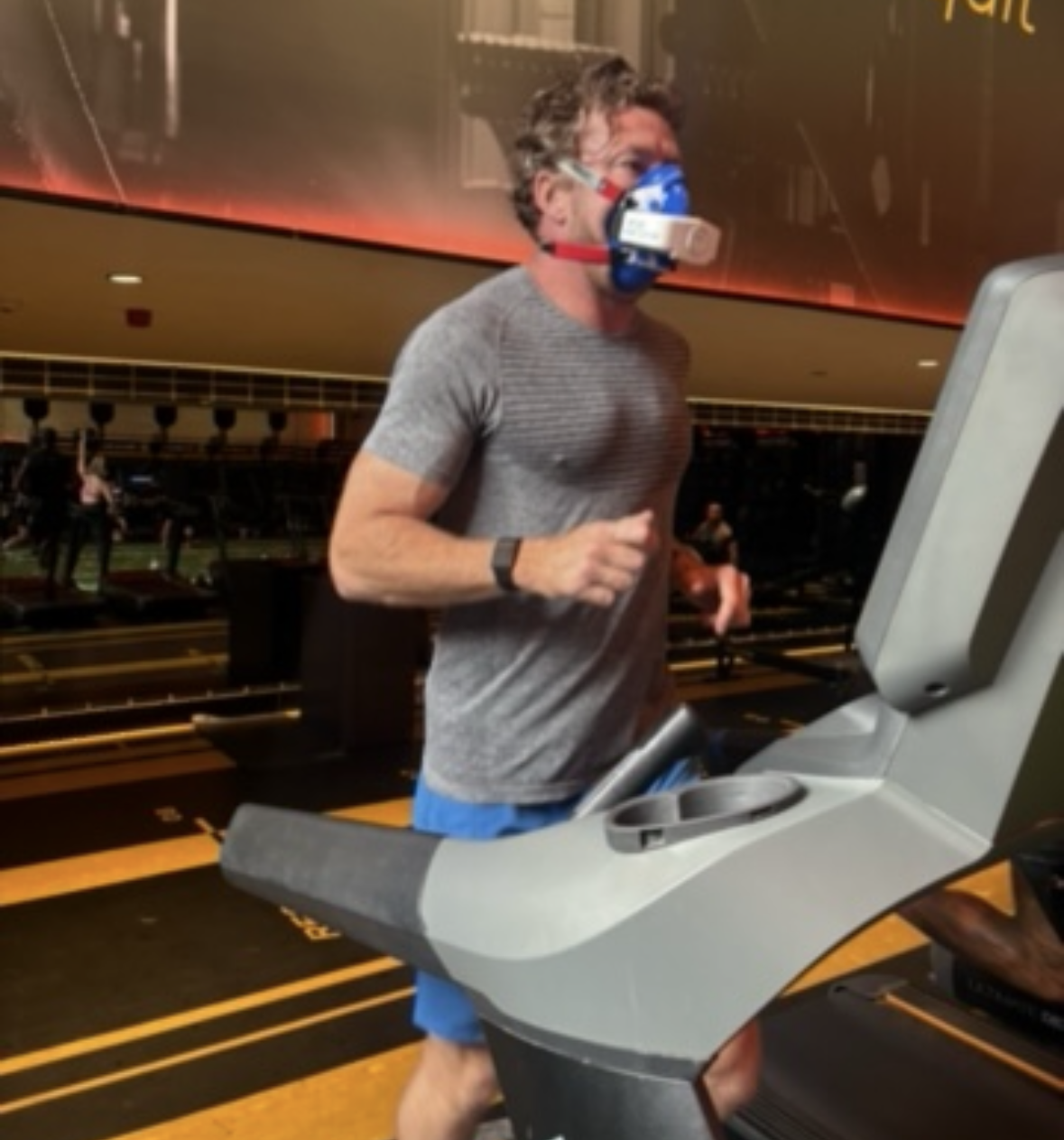
Let’s cut to it: I strapped a mask to my face, hopped on a treadmill, and let a machine that measures actual gas exchange tell me how fit I really am.
No estimating. No wrist-based guesswork. A fully graded, guided by a health professional exercise test of my VO2 max threshold. For more “genuine” science on VO2 max and why it’s super-important, read this Harvard article.
The result: VO2 max of 56.6 mL/kg/min which puts me in the 99th percentile of 43 year olds.
Not “pretty good for a dad.” Ninety-nine. Out of a hundred blokes my age on a treadmill next to me, I’d out-engine 99 of them.
Here’s what that number means, what it took to get there, and — more usefully — what I’m actually going to do with it, because a good score with no follow-up plan is just a number you show off at a barbecue once and then forget.
The Number, And Why It Matters More Than A Fitness Tracker Guess
VO2 max is the gold standard for cardio-respiratory fitness. It measures how much oxygen your body can pull in, ship to your muscles, and actually use under maximal effort. It’s your engine size, full stop — and unlike your Garmin’s “fitness age” party trick, this comes straight off a gas analyzer, not an algorithm’s best guess.
I hit peak VO2 running at 8.1 km/h, heart rate topping out at 184 bpm, moving 146 L/min of air through my lungs at 52 breaths a minute. That’s the body working about as hard as it’s willing to.
Lower VO2max tracks with higher cardiovascular risk. Higher VO2max tracks with lower all-cause mortality.
This isn’t a vanity metric — it’s one of the best single predictors of how long and how well you’ll live.
Definitely worth knowing your number.
The Part That Actually Changes My Training: Ventilatory Thresholds
This is where most people stop paying attention, and it’s the actual useful part.
The test picked up two ventilatory thresholds — VT1 and VT2 — the exact points where my breathing pattern shifts under load:
- VT1 — HR 125 bpm, 5.5 km/h. The ceiling for “still holding a conversation.” Below this is genuine easy pace.
- VT2 — HR 153 bpm, 6.8 km/h. Past this, you’re not talking to anyone. You’re just surviving.
Most people train off generic age-based heart rate zones (220 minus your age, or whatever your watch tells you) and it’s rubbish. These thresholds are built off my actual physiology, from an actual test, which means the training zones below are real — not estimated.
My Actual Training Zones
Here’s the cheat sheet the test spit out for me:
| Zone | Name | Heart Rate | Speed |
| 1 | Warm Up | up to 112 bpm | up to 5 km/h |
| 2 | Fat Burning | 112–125 bpm | 5–5.5 km/h |
| 3 | Endurance | 125–145 bpm | 5.5–6.5 km/h |
| 4 | Vigorous | 145–153 bpm | 6.5–6.8 km/h |
| 5 | Maximal | 153+ bpm | 6.8+ km/h |
This is what tells me whether my “easy run” is actually easy, or whether I’ve been quietly redlining every session for months without realising (spoiler: most dads are).
So What Now? A 99th Percentile Isn’t A Finish Line
Here’s the bit nobody tells you: a great score doesn’t mean you’re done. VO2 max is highly trainable — even from a starting point this high, consistent, targeted training can add another 10–25%. So this isn’t a trophy to mount on the wall. It’s a baseline.
The plan, straight off the back of the results:
- Sprint Interval Training (SIT) — Zone 5, 30 seconds all-out, rest 2–4 minutes, repeat 4–6 times.
- HIIT — Zone 3–4, 3–5 minutes as hard as sustainably possible, rest 3–5 minutes, repeat 3–5 times.
- MICT (steady state) — Zone 2–3, 20–45 minutes continuous.
Rule of thumb: start with whichever of these you’ve done the least. Keep the days either side of a hard session genuinely easy — Zone 1–2, no cheating, no “just a quick tempo effort.” Run this for 4–6 weeks, swap the style of session, repeat, and retest VO2max every 4–6 weeks to see if the number’s actually moving.
The Actual Takeaway
If you’ve been training off a $30 fitness band’s guess at your heart rate zones, or you genuinely don’t know if your “easy days” are easy — get tested properly. It’s not cheap, but it’s the difference between training on vibes and training on data. Numbers don’t lie. Mine said I’m doing plenty right, and there’s still real room to push further.
Now I’ve got a sprint session to go and resent.

Related Posts